

Mixer Grinder RPM: The Ultimate Guide to Speed and Performance
Have you ever wondered why some mixer grinder rpm turn turmeric into fine powder in seconds while others struggle with simple onions? The secret often lies in three little letters: RPM.
When shopping for kitchen appliances, we often look at wattage, jar capacity, or the brand name. But one of the most critical factors determining mixer grinder performance is the speed at which the blades rotate. This speed is measured in Revolutions Per Minute, or RPM.
Understanding mixer grinder RPM is essential for anyone who takes their cooking seriously. Whether you are a home cook trying to make the perfect idli batter or a professional chef needing consistent spice blends, the speed of your motor matters.
In this comprehensive guide, we will dive deep into the science of rpm in mixer grinder technology. We will explore how speed affects grinding efficiency, the difference between domestic and commercial requirements, and why manufacturers like Lordsxtra are setting new standards in high-performance kitchen appliances.
What is RPM in a Mixer Grinder?

RPM stands for Revolutions Per Minute. In the context of a mixer grinder, it refers to the number of times the motor shaft (and consequently the blade) rotates in one minute.
If a mixer grinder has a specification of 18,000 RPM, it means the blades are spinning 18,000 times every 60 seconds at top speed. That is 300 rotations every single second! This incredible speed is what allows the blunt edges of the stainless steel blades to impact ingredients with enough force to pulverize them.
Why Does RPM Matter?
The mixer grinder speed directly correlates to the texture and time it takes to process food.
- High RPM: Ideal for dry grinding hard spices (turmeric, cinnamon) and making fine powders.
- Medium RPM: Perfect for wet grinding (idli/dosa batter, chutneys) where a vortex needs to be created without overheating the batter.
- Low RPM: Used for chopping, blending soft fruits, or whipping liquids.
For a brand like Lordsxtra, finding the perfect balance of torque and speed is an engineering art. A motor that spins too fast without torque will just stop when you add a heavy load. A motor with high torque but low speed won’t give you that fine powder. This is why mixer grinder RPM is a key specification to look for.
The Relationship Between Wattage and RPM
A common misconception is that higher wattage automatically means higher RPM. This isn’t always true.
- Wattage is the power consumption and potential torque (turning force) of the motor.
- RPM is the speed of the motor.
You can have a high-wattage motor (like 1000W) running at a moderate RPM to provide immense crushing power. Conversely, you can have a lower wattage motor spinning at high speeds, but it might struggle with heavy loads.
The best mixer grinder performance comes from a machine that optimizes both. Lordsxtra mixer grinders are designed to maintain high RPM even under load. This means when you fill the jar with soaked rice, the motor has enough power (wattage) to keep the blades spinning at the desired mixer grinder RPM, ensuring a smooth batter every time.
Ideal RPM for Different Grinding Needs
Not all cooking tasks require the same speed. In fact, using the wrong speed can ruin your dish or damage your appliance. This is why most mixer grinders come with a speed control knob (usually 1, 2, 3, and a pulse/incher mode).
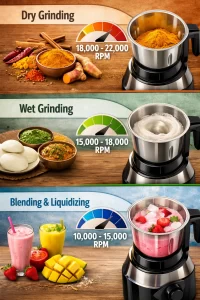
Here is a breakdown of the best rpm for mixer grinder usage based on common kitchen tasks:
1. Dry Grinding (18,000 – 22,000 RPM)
To turn hard spices like dried ginger, turmeric, or pepper into a fine powder, you need high impact. A high rpm mixer grinder is essential here. The blades need to strike the ingredients with high velocity to shatter them.
- Lordsxtra Advantage: Our motors are balanced to reach these speeds without excessive vibration, ensuring your spices are powdered quickly without burning.
2. Wet Grinding (15,000 – 18,000 RPM)
Making pastes for curries or batters for dosa requires a consistent vortex. If the mixer grinder rpm is too high, the friction can heat up the batter, potentially cooking it slightly or affecting the fermentation process of the batter. A medium-high speed is ideal to break down the grains while keeping the mixture relatively cool.
3. Blending and Liquidizing (10,000 – 15,000 RPM)
For milkshakes, lassis, or pureeing tomatoes, extreme speed isn’t necessary. You need a speed that folds the ingredients together. Using the highest mixer grinder speed for a milkshake might result in a frothy mess rather than a creamy drink.
High RPM vs. Low RPM: The Heat Factor
One of the biggest topics in mixer grinder performance discussions is heat.
When blades rotate at 20,000 RPM, they generate significant friction. This friction creates heat. This is known as the motor speed impact grinding effect.
- Pros: Fast grinding means the motor runs for less time.
- Cons: If run for too long, the heat transfers to the food. This can be detrimental for delicate spices (loss of volatile oils/aroma) or coffee beans (altering the flavor profile).
This is why Lordsxtra emphasizes efficiency. Our blades and jars are aerodynamically designed to circulate food effectively. This means you achieve the desired texture in less time, reducing the heat exposure to your ingredients despite the high mixer grinder rpm.
Commercial vs. Domestic Mixer Grinder RPM
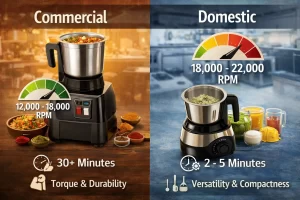
The requirements for a home kitchen differ vastly from a restaurant.
Domestic Mixer Grinders
- Typical RPM: 18,000 to 22,000 (no load).
- Usage: Intermittent. Used for 2-5 minutes at a time.
- Focus: Versatility and compactness.
Commercial Mixer Grinders
- Typical RPM: 12,000 to 18,000 (under load).
- Usage: Continuous. Used for 30+ minutes.
- Focus: Torque and durability.
You might notice that commercial mixer grinder rpm ratings are sometimes lower than domestic ones. This is intentional. Commercial machines prioritize torque (force) over sheer speed. They need to grind 5kg of ginger-garlic paste without stopping. A slightly lower RPM allows for a heavier-duty motor winding that generates massive torque.
Lordsxtra bridges this gap. We offer heavy-duty domestic models that bring commercial mixer grinder rpm stability to your kitchen counter. This means you get the best of both worlds: high speed for spices and high torque for batters.
How to Check RPM Before Buying
Manufacturers often list the “No-Load RPM.” This is the speed of the motor when the jar is empty. However, the “Full-Load RPM” (speed when grinding ingredients) is what really matters for grinding efficiency mixer grinder capability.
While you can’t easily measure this in a shop, here are indicators of a machine that sustains its RPM well:
- Motor Rating: Look for “heavy duty” or copper motors.
- Wattage: Higher wattage (750W and above) generally sustains RPM better under load.
- Brand Reputation: Brands like Lordsxtra are transparent about their specifications and engineer their motors to minimize speed drops when ingredients are added.
The Role of Speed Control Knobs
The rotary switch on your mixer grinder is basically a gear stick for your motor.
- Pulse/Incher: This engages the motor at a specific speed only as long as you hold it. It’s crucial for coarse grinding or crushing ice.
- Speed 1 (Low): Usually around 40-50% of the max mixer grinder rpm. Use this for starting the grinding process.
- Speed 2 (Medium): Around 70-80% of max speed. Good for blending.
- Speed 3 (High): 100% of max speed. For fine powders and tough grinding.
Using the correct speed setting extends the life of your motor. Starting directly at Speed 3 with a jar full of hard turmeric puts immense stress on the motor coupler. It’s always better to start at Speed 1, let the ingredients break down slightly, and then move to higher speeds to utilize the full mixer grinder rpm.
Impact of Blade Design on RPM Efficiency
You can have a motor spinning at 25,000 RPM, but if the blades are poorly designed, you will just get noise and no grinding.
Grinding efficiency mixer grinder technology relies on the synergy between blade aerodynamics and motor speed.
- Blade Shape: Lordsxtra blades are computer-designed to lift food from the bottom of the jar and throw it against the jar walls.
- Impact: When the food hits the walls, it falls back into the center, hitting the spinning blades again.
If the blades are flat or dull, the high mixer grinder rpm just pushes the food to the walls where it sticks, untouched by the blades. This requires you to stop, open the lid, stir, and restart. A well-designed system keeps the cycle going continuously.
Safety and High RPM
With great speed comes the need for safety. A blade spinning at 20,000 RPM is dangerous.
- Lid Locks: High RPM machines must have secure lid locks to prevent the lid from flying off due to internal pressure.
- Anti-Skid Feet: The vibration from high speed can make the machine “walk” across the counter. Vacuum feet are essential.
- Overload Protectors: If something jams the blades at high speed, the motor can burn out instantly. An Overload Protector (OLP) cuts the power to save the motor.
Lordsxtra appliances are built with these safety features as a standard, ensuring that the high kitchen appliance rpm is harnessed safely.
Debunking RPM Myths
There is a lot of marketing fluff surrounding mixer grinder rpm. Let’s bust a few myths.
Myth 1: Higher RPM is always better.
Fact: Not true. Too high an RPM can burn coffee, melt sugar, or turn chutney bitter. Control is better than raw speed. The best rpm for mixer grinder use is a range, not just the highest number.
Myth 2: 25,000 RPM machines grind faster than 20,000 RPM machines.
Fact: Not necessarily. If the 25,000 RPM machine has low torque, it will slow down significantly when you add food. A 20,000 RPM machine with high torque might actually finish the job faster because it maintains its speed.
Myth 3: You need high RPM for soft foods.
Fact: High RPM for soft foods (like tomatoes or onions) often results in a watery puree rather than a thick paste. Lower speeds give better texture control.
Why Lordsxtra is the King of RPM
At Lordsxtra, we don’t just assemble motors; we engineer culinary solutions. We understand that Indian cooking is diverse. The rpm in mixer grinder requirements for a Kashmiri spice blend are different from a Kerala coconut chutney.
Our research and development team focuses on:
- Sustainable Speed: Motors that hold their RPM even when grinding tough turmeric or soaked lentils.
- Cooling Technology: Advanced ventilation systems that keep the motor cool, allowing for longer run times at high mixer grinder speed.
- Balanced Rotors: Precision-balanced motor rotors to reduce noise and vibration, even at top speeds.
When you buy a Lordsxtra mixer grinder, you aren’t just buying a machine with a high number on the box. You are buying a tuned performance instrument where the mixer grinder rpm is optimized for real-world kitchen tasks.
Troubleshooting RPM Issues
Is your mixer grinder running slow? Here is a quick checklist:
- Overloading: You might have put too much in the jar. The motor can’t reach its optimal mixer grinder rpm. Remove some ingredients.
- Voltage Fluctuations: Low voltage input will drastically reduce motor speed.
- Worn Coupler: The plastic teeth connecting the jar to the motor might be worn out, causing slipping.
- Dull Blades: If blades are blunt, they offer more resistance, slowing down the motor.
Regular maintenance ensures your kitchen appliance rpm stays consistent for years.
The Future of Mixer Grinder RPM Technology
As technology advances, we are seeing the introduction of “Smart RPM.”
- BLDC Motors: Brushless DC motors are entering the market. They offer precise speed control, higher torque, and lower noise.
- Smart Sensors: Future machines might sense the load and adjust the mixer grinder rpm automatically—speeding up for hard bits and slowing down as the paste becomes smooth.
Lordsxtra is at the forefront of these innovations, constantly testing new motor technologies to bring you the next generation of grinding efficiency mixer grinder solutions.
Conclusion: Speed with a Purpose
The number of times your mixer grinder blades rotate in a minute is more than just a spec—it’s the difference between a good meal and a great one.
Understanding mixer grinder rpm empowers you to use your appliance better. It helps you choose the right setting for the right ingredient, preserving flavors and textures. It also helps you make a smarter buying decision, looking past the marketing hype to find a machine with genuine performance.
Whether you need the raw power of a high rpm mixer grinder for your spices or the steady torque for your batters, Lordsxtra has a solution tailored for you. We combine high-quality copper motors, aerodynamic blade designs, and robust safety features to deliver the ultimate grinding experience.
Don’t let a sluggish motor hold back your culinary creativity. Upgrade to a Lordsxtra and experience the perfect blend of speed, power, and precision.
Frequently Asked Questions (FAQs)
Q1: What is the ideal RPM for a domestic mixer grinder?
A: For most Indian homes, a mixer grinder with a no-load speed of 18,000 to 22,000 RPM is ideal. This range offers enough speed for fine powdering of spices and enough control for wet grinding.
Q2: Does higher wattage mean higher RPM?
A: No. Wattage is power; RPM is speed. A high-wattage motor ensures that the mixer grinder rpm doesn’t drop significantly when you add a heavy load, providing better performance stability.
Q3: Can I run my mixer grinder at full RPM for a long time?
A: It is recommended to run domestic mixer grinders for 3-5 minutes continuously, then give them a break. Running at max mixer grinder speed for too long can overheat the motor and the food.
Q4: Why does my mixer grinder speed slow down when I add ingredients?
A: This is normal physics. The resistance of the food creates “load.” A good quality motor (like those in Lordsxtra products) will have high torque to minimize this drop in speed, maintaining grinding efficiency mixer grinder performance.
Q5: Is a commercial mixer grinder rpm better for home use?
A: Not necessarily. Commercial machines are bulky and designed for very large quantities. A heavy-duty domestic mixer grinder from Lordsxtra offers similar performance tuned for home quantities.
Q6: Does blade sharpness affect RPM?
A: Indirectly, yes. Dull blades require more force to cut through food, putting more load on the motor and potentially slowing down the mixer grinder rpm. Sharp blades cut efficiently, allowing the motor to spin freely.
Q7: How does Lordsxtra ensure consistent RPM?
A: Lordsxtra uses high-grade copper motors and precision-engineered windings. This ensures that the motor generates sufficient torque to maintain its rpm in mixer grinder operations, even under heavy grinding loads.