

Mixer Grinder Manufacturing Process: From Concept to Kitchen 2026

The hum of a mixer grinder is a familiar sound in millions of homes, especially in India where culinary traditions demand fresh spices and batters daily. But have you ever stopped to wonder about the journey this appliance takes before it reaches your countertop? The mixer grinder manufacturing process is a fascinating blend of engineering precision, robust material science, and rigorous quality assurance. It transforms raw materials like copper, steel, and plastic into the powerful, reliable machines we rely on.
This comprehensive guide takes you behind the scenes of a modern mixer grinder factory. We will explore every stage of the lifecycle, from the initial design sketches to the final packaging. Whether you are curious about how mixer grinders are made, interested in the nuances of appliance manufacturing India, or looking to understand the stringent mixer grinder quality control protocols that ensure safety, this deep dive covers it all.
The Genesis: Design and R&D
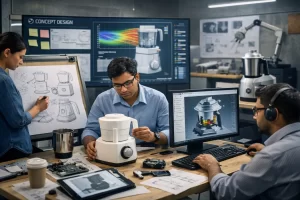
Before a single screw is turned, the mixer grinder manufacturing process begins in the Research and Development (R&D) lab. This is where innovation meets consumer need.
Conceptualization and Market Research
The process starts with understanding the user. In the context of appliance manufacturing India, this means designing for heavy-duty usage. Indian cooking often involves grinding tough ingredients like turmeric roots or soaking wet rice for idli batter. Designers must create a machine that can handle high torque and long run times without overheating.
- User Feedback: Manufacturers analyze customer feedback on existing models to identify pain points—noise levels, jar locking issues, or cleaning difficulties.
- 3D Modeling: Engineers use CAD (Computer-Aided Design) software to create detailed 3D models of the new mixer grinder. This allows them to simulate airflow for motor cooling, test ergonomic handle designs, and ensure the aesthetic appeal matches modern kitchen trends.
Prototyping
Once the digital design is finalized, a physical prototype is created using 3D printing or CNC machining. This prototype undergoes initial testing to validate the design concept. Does the jar sit securely? Is the knob easy to turn? Does the motor fit within the housing? This stage is critical for refining the mixer grinder production process before mass manufacturing begins.
The Heart of the Machine: Motor Manufacturing
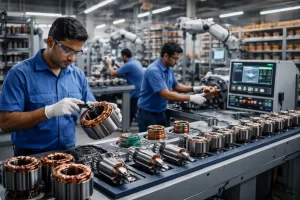
The motor is the soul of a mixer grinder. A significant portion of the mixer grinder manufacturing process is dedicated to building this complex component. Unlike simple assemblers, top-tier manufacturers often build their motors in-house to ensure quality.
Stamping and Stator/Rotor Core Production
The motor consists of a stator (stationary part) and a rotor (rotating part).
- Stamping: High-grade silicon steel sheets are fed into high-speed stamping presses. These presses punch out the intricate laminations that form the core of the stator and rotor.
- Stacking: These laminations are stacked together under high pressure. The precision here is vital; even a micrometer of misalignment can cause vibration and noise in the final product.
Winding
This is a delicate phase where kitchen appliance manufacturing requires high precision.
- Copper Winding: Automated winding machines wrap copper wire around the slots of the stator and rotor cores. The gauge and quality of the copper wire determine the motor’s efficiency and heat resistance. In commercial mixer grinder manufacturing, thicker gauge wires and high-temperature insulation are used to withstand continuous operation.
- Varnishing: The wound cores are dipped in insulating varnish and baked in ovens. This solidifies the windings, protects them from moisture and dust, and prevents short circuits.
Balancing the Rotor
A spinning rotor must be perfectly balanced. If it’s off-balance, the mixer grinder will vibrate violently and “walk” across the kitchen counter.
- Dynamic Balancing: The rotors are placed on dynamic balancing machines. These machines spin the rotor and detect any imbalance. Automated drills then remove tiny amounts of weight from specific spots to achieve perfect equilibrium. This step is a non-negotiable part of mixer grinder quality control.
The Body and Jars: Injection Molding and Metal Forming
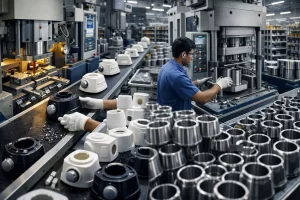
While the motor is being built, parallel production lines focus on the external components—the body, the jars, and the blades.
Plastic Injection Molding
The outer body of the mixer grinder is typically made of ABS (Acrylonitrile Butadiene Styrene) plastic, known for its impact resistance and electrical insulation.
- The Process: Plastic granules are melted and injected into massive steel molds under high pressure. These molds shape the base unit, the lids, and the jar handles.
- Aesthetic Finishes: Advanced molding techniques allow for various finishes, from high-gloss piano black to matte textures. This stage also involves molding the intricate couplers and safety lock components essential for the mixer grinder protection system.
Stainless Steel Jar Fabrication
The jars are the workhorses that interact directly with food.
- Deep Drawing: High-quality stainless steel sheets (usually food-grade SS 304) are placed in hydraulic presses. A process called “deep drawing” stretches the flat steel sheet into the cup shape of the jar without breaking it.
- Polishing: The formed jars undergo multi-stage polishing to remove sharp edges and achieve a mirror-like finish inside and out. A smooth interior is crucial for hygiene, ensuring no food particles get trapped.
Blade Manufacturing
The blades are the cutting edge of the mixer grinder production process.
- Stamping and Sharpening: Blades are stamped from hardened stainless steel. Depending on their function (wet grinding, dry grinding, or chutney), they are shaped differently.
- Hardening: The blades undergo heat treatment to harden the steel, ensuring they stay sharp even after grinding tough spices for years.
Also, Read: Why Metal Body Mixer Grinders Are Better for Commercial Kitchens
The Convergence: Mixer Grinder Assembly Process
This is where all the separate components come together. The mixer grinder assembly process is typically organized as a moving assembly line, where skilled technicians and automated robots work in tandem.
Sub-Assembly
Before the main line, sub-assemblies are prepared.
- Jar Assembly: The steel jars are fitted with handles, blade assemblies, and base sockets (couplers). Technicians ensure the rubber gaskets and washers are seated correctly to prevent leaks—a common issue if mixer grinder testing is lax.
- Motor Housing: The motor is fitted into the bottom casing of the body. Rubber vibration dampeners are installed to isolate the motor’s vibration from the body, reducing noise.
Main Assembly Line
- Motor Installation: The sub-assembled motor is secured into the main body shell.
- Wiring and Switches: The speed selector switch (rotary knob) and the overload protection switch are wired to the motor. This wiring must be precise and secure to meet safety standards.
- Top Cover Fitting: The top cover of the mixer body is screwed into place.
- Coupler Attachment: The plastic coupler (the part that connects the motor to the jar) is screwed onto the motor shaft.
- Base Plate: Finally, the bottom plate with the vacuum suction feet is attached. These feet are critical for stability during high-speed operation.
This streamlined mixer grinder assembly process ensures efficiency and consistency, allowing a mixer grinder factory to produce thousands of units daily.
Critical Checkpoint: Mixer Grinder Quality Control
Quality control (QC) is not just a final step; it is embedded throughout the mixer grinder manufacturing process. However, the final inspection is the most rigorous.
In-Process QC
throughout the assembly line, inspectors check for visual defects, loose screws, or misalignment. If a defect is found, the unit is pulled off the line immediately.
Performance Testing
Every single unit typically undergoes a “run test.”
- Voltage Testing: The machine is run at different voltages to ensure it can handle fluctuations, a common occurrence in many markets.
- Load Testing: In commercial mixer grinder manufacturing, units are often tested with actual loads (like water or simulated weights) to ensure the motor delivers the specified torque without overheating.
- Noise and Vibration: Sound meters measure the decibel levels to ensure they fall within acceptable limits. Vibration sensors check for stability.
Safety Testing (Hi-Pot Test)
Safety is paramount in kitchen appliance manufacturing.
- High Potential (Hi-Pot) Test: A high voltage is applied to the unit to check the insulation. This ensures that no current leaks to the outer body, protecting the user from electric shocks. This is a mandatory step for compliance with standards like BIS (Bureau of Indian Standards).
Specialized Processes for Commercial Mixer Grinders
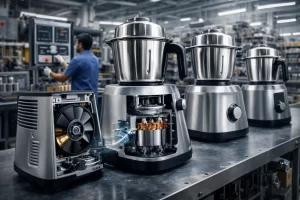
The commercial mixer grinder manufacturing process differs slightly from domestic models. These machines are built for restaurants and hotels and must endure punishing environments.
- Robust Materials: Instead of ABS plastic bodies, commercial models often feature full stainless steel or heavy-duty aluminum die-cast bodies for superior durability.
- Enhanced Cooling: The mixer grinder manufacturing process for commercial units involves designing advanced airflow systems. Larger fans and strategic venting are engineered to keep the motor cool during continuous operation, which might last for hours in a busy kitchen.
- Heavy-Duty Bearings: Instead of standard bushings, commercial motors use sealed ball bearings to reduce friction and withstand higher radial loads.
The Role of Appliance Manufacturing India
India has emerged as a global hub for appliance manufacturing India, particularly for mixer grinders. The unique culinary requirements of the region have driven manufacturers to perfect the art of making robust, high-torque machines.
- Localization: The mixer grinder manufacturing process in India is heavily localized. From the copper for motors to the steel for jars, the supply chain is largely domestic.
- Innovation Center: Global brands often set up R&D centers in India specifically to design mixer grinders because if a machine can survive the rigorous demands of an Indian kitchen, it can survive almost anywhere.
- Export Hub: The expertise developed in local mixer grinder factory setups has led to a boom in exports. Indian-made mixer grinders are now found in kitchens across the Middle East, Africa, and Southeast Asia, prized for their durability and value.
Packaging and Logistics
The final stage of the mixer grinder manufacturing process is packaging.
- Protection: The unit is placed in a thermocol (polystyrene) or molded pulp shell to protect it from shocks during transport.
- Accessories: Jars, lids, spatulas, and the user manual are packed alongside the main unit.
- Final Weighing: The packed box is weighed. If the weight is off by even a few grams, it indicates a missing part (like a lid or a blade), and the box is rejected.
Understanding the Economics: How Mixer Grinders Are Made Efficiently
Efficiency in the mixer grinder production process drives affordability.
- Automation: Modern factories use robotic arms for dangerous or repetitive tasks like stamping and welding. This speeds up production and reduces human error.
- Just-In-Time (JIT) Manufacturing: Components arrive at the assembly line exactly when needed, reducing storage costs and inventory waste.
- Standardization: By using the same motor or body mold across different models (with slight cosmetic changes), manufacturers can achieve economies of scale, keeping the final price lower for consumers.
Environmental Considerations in Manufacturing
Sustainable kitchen appliance manufacturing is becoming a priority.
- Recyclable Materials: Manufacturers are increasingly using recyclable plastics and packaging materials.
- Energy Efficient Motors: The R&D phase focuses on creating motors that deliver high power with lower electricity consumption.
- Waste Management: In a responsible mixer grinder factory, metal scraps from stamping and plastic runners from molding are collected and recycled back into the production loop.
The Future of the Mixer Grinder Manufacturing Process
The industry is not standing still. The future of how mixer grinders are made involves smart technology.
- IoT Integration: Future manufacturing lines will embed sensors into the appliances that can communicate with the factory during testing, providing data that helps improve the next batch.
- BLDC Motors: Brushless DC (BLDC) motors are entering the market. These are lighter, quieter, and more efficient than traditional universal motors. The mixer grinder manufacturing process for BLDC motors is entirely different, requiring advanced electronic controllers instead of carbon brushes.
Conclusion: A Marvel of Modern Engineering
The next time you switch on your mixer to blend a smoothie or grind spices, take a moment to appreciate the engineering marvel on your counter. The mixer grinder manufacturing process is a complex symphony of design, material science, and precision assembly. From the winding of the copper coils to the final mixer grinder testing that ensures your safety, every step is calculated to deliver performance and reliability.
Whether it is the robust demands of commercial mixer grinder manufacturing or the high-volume efficiency of appliance manufacturing India, the industry continues to evolve. Understanding how mixer grinders are made gives us a greater appreciation for the tools that make our daily lives easier and our food tastier. It is a journey from a raw concept in a designer’s mind to an indispensable partner in your kitchen—a journey defined by quality, innovation, and engineering excellence.
Also, Read: Commercial Mixer Grinder Buying Guide – Things to Check Before Purchase
FAQs for Mixer Grinder Manufacturing Process
1. What is the Mixer Grinder Manufacturing Process?
The Mixer Grinder Manufacturing Process is the complete production cycle that includes design, motor manufacturing, jar fabrication, blade production, assembly, quality testing, and packaging before distribution.
2. How are mixer grinder motors manufactured?
Motors are produced through silicon steel stamping, copper winding, varnishing, rotor balancing, and insulation testing to ensure torque efficiency, durability, and thermal resistance.
3. Which materials are used in the mixer grinder manufacturing process?
Common materials include copper windings, silicon steel laminations, ABS plastic bodies, stainless steel (SS 304) jars, hardened steel blades, and insulated electrical wiring.
4. How does quality control work in mixer grinder manufacturing?
Quality control includes voltage testing, load testing, noise and vibration analysis, insulation (Hi-Pot) testing, and final performance checks to ensure safety and durability.
5. What is the role of injection molding in mixer grinder production?
Injection molding is used to create durable ABS plastic bodies, jar handles, lids, and couplers with high precision and consistent finish.
6. How are mixer grinder blades manufactured?
Blades are stamped from stainless steel sheets, shaped according to function, heat-treated for hardness, and sharpened for long-term performance.
7. What is the difference between domestic and commercial mixer grinder manufacturing?
Commercial mixer grinders use heavy-duty motors, stainless steel bodies, advanced cooling systems, and sealed ball bearings to handle continuous industrial use.
8. Why is rotor balancing important in the mixer grinder manufacturing process?
Rotor balancing prevents excessive vibration, reduces noise, increases motor lifespan, and ensures stable operation during high-speed grinding.
9. How does India contribute to mixer grinder manufacturing?
India is a major hub due to localized supply chains, heavy-duty product demand, advanced R&D, and large-scale production capacity for domestic and export markets.
10. What is the future of the mixer grinder manufacturing process?
The future includes BLDC motor technology, IoT-enabled testing systems, energy-efficient designs, sustainable materials, and automated production lines.