

Mixer Grinder Buying Guide for Home & Commercial Use

Whether you are whipping up a quick chutney for a family dinner or grinding kilos of spices in a busy restaurant kitchen, a mixer grinder is an essential appliance—and this mixer grinder buying guide will help you choose the right one. It is the workhorse that transforms raw ingredients into smooth pastes, fine powders, and consistent batters.
With the market flooded with options ranging from compact domestic models to heavy-duty commercial machines, making the wrong choice can be costly. An unsuitable mixer grinder may lead to burnt-out motors, uneven textures, and wasted investment over time.
For home users, the wrong appliance often struggles with tough ingredients like turmeric or overheats while preparing dosa batter. In commercial kitchens, a poor-quality mixer grinder can disrupt workflow and slow down operations during peak hours.
In this comprehensive guide, we will break down the essential differences between domestic and commercial units, explore critical technical specifications like motor wattage and blade quality, and provide actionable mixer grinder selection tips. By understanding exactly how to choose a mixer grinder, you can ensure efficiency, durability, and culinary excellence in your kitchen.
Understanding Mixer Grinders: A Complete Buying Guide

At its core, a mixer grinder is a versatile kitchen appliance that combines the functions of mixing and grinding. It uses a high-speed motor to rotate stainless steel blades that chop, pulverize, and blend ingredients. While the basic mechanism remains the same across models, the scale and durability differ vastly between a domestic mixer grinder and a commercial mixer grinder India relies on for heavy-duty tasks.
In Indian cooking specifically, where wet grinding (for idli/dosa batter) and dry grinding (for masalas) are daily rituals, this appliance is non-negotiable. Unlike a food processor that chops or a blender that liquefies, a mixer grinder offers the torque and speed required to turn hard spices into fine powder and soaked grains into smooth paste.
Why is it a must-have?
- Versatility: It handles liquids, dry powders, and pastes.
- Speed: It drastically reduces prep time compared to manual grinding.
- Consistency: It ensures uniform texture, which is crucial for flavor release in cooking.
Mixer Grinder Buying Guide: Key Factors to Consider
When evaluating a mixer grinder for home and commercial use, several technical factors determine performance. Ignoring these specs is the most common reason for buyer’s remorse.
Usage Type: Home vs. Commercial
The first step is defining the workload.
- Home Use: Typically involves running the machine for 5–10 minutes at a time, a few times a day. The focus here is on compactness, aesthetics, and noise reduction.
- Commercial Use: Requires a machine capable of running continuously for 30–60 minutes or more without overheating. These units prioritize motor cooling, robust build, and capacity over looks.
Motor Power: Wattage Matters
The wattage indicates the power of the motor and its ability to handle load.
- 500W – 600W: Ideal for basic domestic tasks like making chutneys, grinding soft spices, and blending juices.
- 750W: The sweet spot for most Indian kitchens. It can handle tough ingredients like turmeric, coconut, and idli batter with ease.
- 900W – 1000W+: Essential for a heavy duty mixer grinder or commercial applications. High wattage provides the torque needed to grind large quantities quickly without stalling.
Also Read: Top 10 Liter Heavy Duty Mixer Grinder Machines in India
Jar Types & Capacity: Mixer Grinder Buying Guide
The versatility of a mixer grinder depends on its jars.
- Liquidizing Jar: Usually the largest (1.2L – 1.5L), designed for milkshakes, lassis, and wet grinding.
- Dry Grinding Jar: A medium-sized jar (0.8L – 1L) for spices and coffee beans.
- Chutney Jar: The smallest jar (0.3L – 0.5L) for pastes and dips.
- Material: Always insist on high-quality stainless steel jars. They resist rust, don’t absorb odors, and are durable. Polycarbonate jars are good for visibility but may crack under heavy impact.
Blades & Build Quality
The blade design decides how efficiently the mixer grinds.
- Material: Grade 304 stainless steel is the industry standard for rust resistance and sharpness retention.
- Design: Look for specialized blades. For instance, ‘pounding blades’ with thick edges are better for dry spices, while sharp, angled blades are better for purees.
- Body Build: ABS plastic is standard for home units as it is shock-proof and lightweight. Commercial units often feature metal bodies for stability and heat dissipation.
Speed Settings
Control is key. A standard mixer grinder should have at least three speed settings (low, medium, high) and a ‘pulse’ or ‘incher’ mode.
- Pulse Mode: Crucial for chopping vegetables without turning them into paste or for initial crushing of hard ingredients.
- Commercial Control: Some high-end commercial units offer stepless speed regulation for precision texture control.
Safety Features
High-speed motors pose safety risks if not managed correctly.
- Overload Protection (OLP): This is a circuit breaker that cuts off power if the motor overheats or the jar is overloaded, preventing motor burnout.
- Locking System: Ensure the mixer has a safety lock that prevents the motor from starting unless the jar is securely fixed to the base unit.
- Anti-Slip Feet: Vacuum suction feet are essential to keep the machine stable during heavy vibration.
Ease of Cleaning & Maintenance
Hygiene is paramount, especially in commercial settings.
- Detachable Blades: These make it easier to clean food residue stuck under the blades.
- Gaskets: Rubber gaskets should be easily removable and replaceable, as they are prone to wear and tear.
- Design: Avoid models with deep crevices or intricate designs where food particles can accumulate.
Types of Mixer Grinders
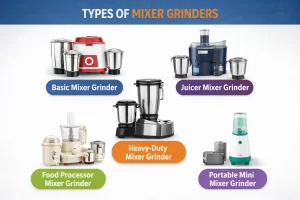
Navigating the kitchen appliance buying guide landscape requires understanding the specific categories available.
Domestic Mixer Grinders
These are the standard units found in households. They are compact, aesthetically pleasing, and usually range from 500W to 750W. They are designed for intermittent use and focus on user-friendly features like easy-grip handles and low noise.
Commercial Mixer Grinders
Built like tanks, these machines are designed for restaurants, canteens, and juice bars. They often feature motors ranging from 1200W to 2000W. They come with extra-large jars (2L+) and enhanced cooling systems to run continuously. A commercial mixer grinder India market favorite will often prioritize raw power and serviceability over sleek design.
Heavy Duty Mixer Grinders
This is a hybrid category often suitable for large families or small catering businesses. They usually sit in the 900W to 1200W range. They bridge the gap by offering the durability of commercial units with the footprint of domestic ones.
Multipurpose Juicer Mixer Grinders (JMG)
These units come with a specialized centrifugal juicing attachment. While versatile, they are often jack-of-all-trades masters of none. Dedicated mixer grinders usually offer better grinding performance than JMG combos.
Common Applications of Mixer Grinders

Understanding mixer grinder features is easier when viewed through the lens of daily tasks.
- Spice Grinding: Converting whole spices like coriander, cumin, and red chilies into fine powders. This requires high RPM (rotations per minute) and a dry grinding jar.
- Batter Preparation: Making smooth, aerated batter for idlis, dosas, and vadas. This requires high torque and a wet grinding jar to handle the thick consistency without overheating.
- Chutneys and Sauces: Quick emulsification of coconut, herbs, and chilies. The small jar is critical here to ensure the blades engage with small quantities of ingredients.
- Commercial Purees: Restaurants need to produce liters of tomato or onion puree daily. Commercial mixers handle this volume efficiently, ensuring consistent gravy textures.
- Nut Butters & Smoothies: High-power mixers can crush ice for smoothies and grind nuts into oily butters, a task that often burns out lower-wattage motors.
Features to Look for in a Mixer Grinder
Beyond the basics, modern mixer grinder selection tips involve looking at quality-of-life features.
- Noise Levels: Mixer grinders are notoriously noisy (80-90 dB). Look for models with insulated casings or “silent” technology if you have an open kitchen or sensitive environment.
- Energy Efficiency: A higher wattage doesn’t always mean higher electricity bills if the motor is efficient. Copper-wound motors generally offer better efficiency and longevity than aluminum ones.
- Compact Design: Kitchen real estate is valuable. Vertical stack designs (tower shape) save counter space compared to older L-shaped models.
- Smart Controls: Some premium models now offer pre-set menus (e.g., a “batter” button) that automatically cycle through speeds and stop when the cycle is done.
- Couplers: The plastic component connecting the jar to the motor. High-quality nylon couplers are durable and easy to replace, whereas cheap plastic ones strip easily.
How to Choose the Best Mixer Grinder in India
The Indian market is unique due to specific culinary needs. Here is a roadmap to finding the best mixer grinder in India.
- Assess Your Menu: Do you grind turmeric or make idli batter daily? If yes, do not settle for anything less than 750W. A 500W motor will struggle and eventually fail.
- Check the Brand: Service availability is crucial. Established brands in India offer widespread service networks. If a coupler breaks or a gasket needs replacing, you need spare parts to be readily available.
- Inspect the Jars: Pick up the jars. They should feel heavy. Lightweight jars often dent easily, affecting the blade rotation.
- Listen to the Motor: If buying offline, ask for a demo. The motor should sound smooth, not screechy. A low hum indicates a well-balanced motor; a high-pitched whine often suggests poor build quality.
- Warranty: A standard warranty is 2 years on the product and 5 years on the motor. Any brand offering less suggests a lack of confidence in their product’s longevity.
Why a Proper Mixer Grinder Buying Guide Matters
Why invest time reading a mixer grinder buying guide?
- Cost Efficiency: Buying a cheap mixer that burns out in six months is more expensive than buying a quality one that lasts five years.
- Performance: The right texture of spices affects the taste of your food. A good grinder releases essential oils; a bad one overheats and cooks the spices during grinding, altering the flavor profile.
- Safety: Cheap, unbranded mixers are a safety hazard. They often lack overload protection and proper earthing, posing shock risks.
- Operational Flow: In a commercial kitchen, if the mixer goes down, the prep station stops. Reliable equipment is the backbone of operational efficiency.
Whether you are equipping a new home or upgrading a commercial kitchen, treating the mixer grinder as an investment rather than an expense is the key to long-term satisfaction.
FAQs Section
- How do I choose the right mixer grinder for home use?
Focus on your family size and cooking habits. For a family of 4 dealing with standard Indian cooking (masalas, batters), a 750W mixer grinder with 3 jars is the gold standard. - What is the difference between domestic and commercial mixer grinders?
The main differences are motor power and running time. Domestic mixers (500-750W) are for short bursts. Commercial mixers (1000W+) have robust cooling systems allowing them to run continuously for 30+ minutes without overheating. - What is the ideal wattage for a heavy-duty mixer grinder?
For heavy-duty tasks like grinding turmeric, tough meats, or large batches of batter, aim for 900W to 1000W. This ensures the motor has enough torque to grind without stalling. - Are mixer grinders with multiple jars better?
Not necessarily better, but more versatile. However, quality trumps quantity. It is better to have 3 high-quality stainless steel jars than 5 flimsy ones. - How to maintain a mixer grinder for long-term use?
Don’t overload the jars (fill only up to 75% capacity). Let the motor cool down between cycles. Clean the jars immediately after use to prevent corrosion, and check the carbon brushes annually if usage is high. - Which is the best mixer grinder in India for commercial use?
Look for brands that specialize in commercial equipment rather than just upscaled domestic models. Features like full metal bodies, heavy-duty copper motors, and service guarantees are indicators of the best commercial units.
Also, Read: Top 30 Commercial Mixer Grinder Brands in B2B Industries