

Home vs Commercial Mixer Grinder: Which One Do You Need?

Buying a new kitchen appliance is always an exciting upgrade for your cooking space. However, choosing the right tool can often feel overwhelming due to the sheer number of options available. When it comes to grinding spices, making batters, or blending smoothies, the mixer grinder is the king of the kitchen. But the biggest question buyers face is deciding between a standard model and a heavy-duty one. This guide focuses on the critical comparison of home vs commercial mixer grinder models. We will explore everything from motor power to jar capacity to help you decide.
By the end of this post, you will understand exactly which machine suits your specific needs. Whether you run a café or cook for a family of four, we have the answers you are looking for.
Understanding the Basics: What Defines Them?
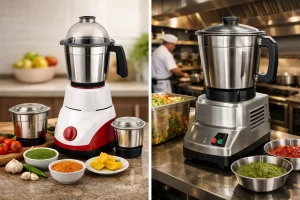
Before diving into technical specs, it is important to define what these machines actually are. A home mixer grinder is designed for everyday, domestic tasks.
These appliances are lightweight, compact, and built for intermittent usage throughout the day. They handle things like chutney, curry pastes, and fruit juices with ease.
On the other hand, a commercial mixer grinder is a beast built for endurance. These machines are engineered to run for hours without overheating or breaking down.
They are typically found in restaurants, juice bars, and catering businesses. Understanding this fundamental difference is the first step in making a smart purchase.
The Core Difference: Purpose and Usage
The primary distinction lies in the mixer grinder usage. Home models are meant for short bursts of activity. You might run them for two minutes to grind coffee beans or five minutes for idli batter.
If you push a domestic machine beyond its limits, you risk burning out the motor. They need rest periods to cool down between grinding sessions.
Commercial units, however, are designed for continuous operation. They can grind kilograms of spices or liters of batter without needing a break.
This durability makes them essential for businesses where time is money. Using a domestic machine in a commercial setting will almost certainly void the warranty.
Analyzing Power: The Motor Strength
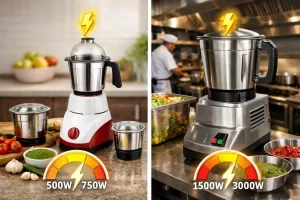
One of the most significant factors in the home vs commercial mixer grinder debate is the motor. This is where the mixer grinder power difference becomes very clear.
Domestic mixers usually range between 500 Watts to 750 Watts. This is sufficient for most household tasks like making purees or grinding dry spices.
Some high-end domestic models might reach 900 Watts or 1000 Watts. These are often marketed as “heavy-duty” for home use but still differ from true commercial units.
Commercial grinders start where home models end. They typically range from 1200 Watts all the way up to 3000 Watts or more.
This immense power allows them to crush hard ingredients like turmeric roots or large quantities of grains instantly. The motor construction is also more robust to handle the heat.
Capacity Matters: How Much Can You Grind?
The next major point of comparison is the mixer grinder capacity comparison. Home kitchens usually deal with small to medium quantities of food.
Therefore, domestic mixer jars range from 0.4 liters for chutneys to 1.5 liters for liquidizing. This is perfect for a family meal but inadequate for a crowd.
Commercial mixers come with significantly larger jars. It is common to see jars ranging from 2 liters to 5 liters or even more.
Imagine trying to grind 5 kilograms of ginger-garlic paste in a small home jar. You would have to do it in ten batches, wasting precious time.
A commercial unit handles that volume in a single go. This efficiency is why restaurants invest in larger equipment despite the higher cost.
Durability and Build Quality
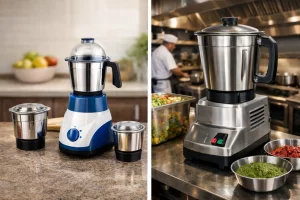
When discussing domestic vs commercial mixer grinder models, build quality is a huge differentiator. Home mixers often use high-quality ABS plastic for the body.
This makes them lightweight, attractive, and easy to clean. They come in various colors to match your kitchen decor and look sleek on the countertop.
Commercial mixers prioritize function over form. They almost exclusively feature stainless steel bodies or heavy-duty metal casings.
This rugged construction protects the motor from external damage and heat. They are built to withstand the rough handling of a busy commercial kitchen environment.
The jars in commercial units are also made of thicker gauge steel. This ensures they don’t dent or crack when processing hard ingredients daily.
Also, Read: Commercial Mixer Grinder Buying Guide – Things to Check Before Purchase
Speed Controls and Operation
The way you control the machine also varies. Home mixers typically come with a simple rotary knob offering three speeds and a pulse function.
This is user-friendly and sufficient for standard recipes. You can easily switch between low speed for chopping and high speed for fine grinding.
Commercial units often have more simple, industrial controls. Some might just have an On/Off switch because they are designed to run at full power constantly.
Others might feature more advanced speed regulation systems to prevent motor strain. The focus here is on reliability rather than having multiple unnecessary settings.
Some advanced commercial blenders do offer variable speed dials. This allows chefs precise control over the texture of sauces and purees.
Runtime and Overload Protection
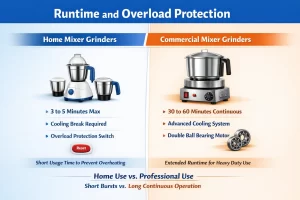
We touched on this earlier, but runtime deserves its own section. A key difference between home and commercial mixer grinder models is how long they can stay on.
Manufacturers usually recommend running a home mixer for no more than 3 to 5 minutes at a stretch. After that, it needs a cooling break.
If you ignore this, the overload protection switch (the red button at the bottom) will trip. This is a safety feature to save the motor from burning out.
Commercial mixers have advanced cooling systems. They often feature powerful fans or double ball bearing motors that dissipate heat efficiently.
This allows them to run for 30 to 60 minutes continuously. For a busy hotel kitchen, this continuous runtime is non-negotiable.
The Noise Factor
If you value a quiet kitchen, this section is important. Generally speaking, all mixer grinders make noise due to the high-speed motor.
However, heavy duty mixer grinder models designed for commerce are significantly louder. The high-wattage motor generates a lot of sound and vibration.
In a bustling restaurant kitchen, this noise is drowned out by other sounds. But inside a small apartment, a commercial mixer can be deafening.
Home mixers are designed with noise reduction in mind. While not silent, they are tolerable for the short duration they are used.
If you plan to buy a high-power machine for home, check the noise levels rating. Some premium brands now offer “silent” technology even in powerful models.
Blade Design and Efficiency
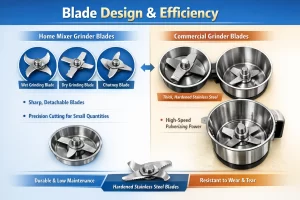
The blades are the workhorses of the appliance. In kitchen mixer grinder types meant for homes, blades are usually detachable or fixed into specific jars.
They are sharp and designed for precision cutting of small quantities. You have specific blades for wet grinding, dry grinding, and chutneys.
Commercial blades are thicker and blunter. They rely on the sheer force and speed of the motor to pulverize ingredients rather than slicing them.
These blades are made of hardened stainless steel to resist wear and tear. They rarely need sharpening even after months of heavy use.
The shape of the blade assembly in commercial units also promotes better circulation. This ensures that food doesn’t get stuck at the bottom of the large jar.
Maintenance and Repairs
Maintaining a home appliance is relatively easy. Most parts are detachable and can be washed in the sink. Spare parts like gaskets and couplers are widely available.
Service centers for popular home brands are easy to find in most cities. If something breaks, it is usually a quick and affordable fix.
Commercial mixers require a bit more attention. Because they are heavy, moving them around for cleaning is difficult.
You often have to clean them in place. Repairs can also be more expensive due to the cost of heavy-duty parts.
However, commercial machines break down far less frequently. Their robust build means you won’t be visiting the repair shop often if you treat them right.
Space and Portability
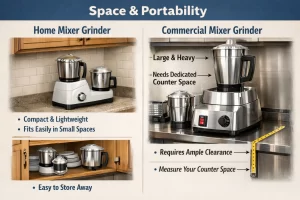
Kitchen real estate is valuable. A home mixer grinder is designed to have a small footprint. It fits easily under cabinets or in tight corners.
They are also light enough to be stored away in a cupboard when not in use. This portability is great for smaller kitchens.
A commercial mixer grinder is bulky and heavy. Once you place it on a counter, it usually stays there.
They take up significant vertical and horizontal space. You need a dedicated station for a commercial machine.
Before buying a commercial unit for your home, measure your counter space. Ensure you have enough clearance for the large jars as well.
Cost Considerations
Price is often the deciding factor for many buyers. Naturally, there is a massive price gap in the domestic vs commercial mixer grinder market.
A good quality home mixer can cost anywhere from $30 to $150 depending on the brand and features. This is an affordable investment for most households.
Commercial grinders are capital investments. They can range from $300 to over $1000. High-end blenders used in coffee chains can be even more expensive.
You are paying for the motor power, material quality, and longevity. For a business, this cost is amortized over thousands of uses.
For a home user, spending $500 on a mixer might be overkill. Unless you have specific heavy-duty needs, a standard model offers better value.
Energy Consumption
With great power comes higher electricity bills. The mixer grinder power difference directly impacts energy consumption.
A 750-watt home mixer uses relatively little electricity, especially since it runs for only a few minutes a day. It has a negligible impact on your monthly utility bill.
A 2000-watt commercial grinder draws a lot of current. If used for extended periods, it will reflect in your energy costs.
In a commercial setting, this is a distinct operating expense. For home users, it is something to consider if you are energy conscious.
Also, commercial units may require a specific power outlet. Standard home sockets might not handle the amperage required by very large industrial machines.
Safety Features
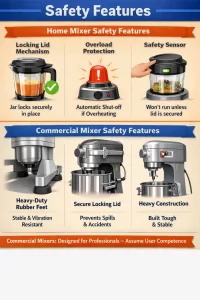
Safety is paramount in any kitchen equipment. Home mixers come with standard safety features like locking jars and overload protectors.
Some modern home units also have safety sensors. The motor won’t start unless the lid is properly secured.
Commercial mixers prioritize operator safety too, but in different ways. They are heavy to prevent wobbling or “walking” across the counter during operation.
They often have heavy-duty rubber feet or vacuum suction bases. The lids usually have strong locking mechanisms to prevent explosions of hot liquids.
However, commercial machines assume a level of professional competence. They might lack some of the “child-lock” style safety features found in home appliances.
Aesthetic Appeal
Let’s be honest, looks matter in a home kitchen. Brands design home mixer grinder models to be visually appealing.
You can find them in florals, metallics, and sleek matte finishes. They are designed to complement your microwave and toaster.
Commercial mixers have an industrial aesthetic. They look like tools, not decorations. The finish is usually plain stainless steel or heavy-duty plastic.
They are built to look professional and hygienic. While some people love the industrial look, it might clash with a cozy, cottage-style kitchen.
If aesthetics are your top priority, the home version wins hands down. But if you prefer a rugged, chef-style kitchen, the commercial look fits right in.
Also, Read: Best Commercial Mixer Grinder in India for Restaurants & Hotels
Who Needs a Commercial Mixer at Home?
Is there ever a reason to buy a commercial mixer grinder for home use? Yes, there are specific scenarios where it makes sense.
If you have a very large family and cook in bulk daily, a standard mixer might struggle. A small commercial unit could save you time.
Home chefs who make their own nut butters, flours, or spice blends frequently benefit from the extra power. A 750W motor often struggles with almond butter.
If you are an aspiring baker or run a small catering business from home, you need commercial gear. Domestic machines aren’t built for “home business” volume.
Also, food enthusiasts who want “restaurant-quality” smooth textures often upgrade. High-power blenders create a silkiness that standard mixers cannot replicate.
Who Should Stick to a Home Mixer?
For 95% of households, a standard home mixer grinder is the perfect choice. If your cooking involves basic curries, chutneys, and idli batter, you are covered.
If you only use the machine once or twice a day for a few minutes, there is no need to overspend. A 750W motor is incredibly capable.
Those with limited kitchen space should definitely stick to domestic models. A commercial unit will dominate your counter and become a nuisance.
If you are on a budget, a home mixer gives you the best return on investment. You get versatility without breaking the bank.
Finally, if you value a quiet kitchen environment, avoid the industrial machines. The noise of a commercial grinder can be very disruptive in a home setting.
Key Features to Look for in Home Mixers
If you have decided on a home model, what should you look for? First, aim for at least 750 Watts of power.
This ensures you can handle tough ingredients like coconut and turmeric. Lower wattage motors (500W) are okay for soft grinding but struggle with heavy loads.
Look for a model with at least three jars. You need a small one for chutney, a medium one for dry grinding, and a large one for wet grinding.
Check the quality of the couplers (the plastic part connecting the jar to the motor). High-quality couplers last longer and prevent slippage.
Ensure the brand offers a good warranty. A 2-year product warranty and a 5-year motor warranty are standard for good brands.
Key Features to Look for in Commercial Mixers
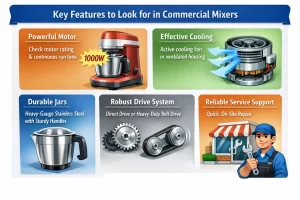
If you are in the market for a commercial mixer grinder, prioritize the motor rating. Look for continuous run time ratings.
The cooling mechanism is critical. Ask if the machine has active cooling fans or ventilated housing to keep the motor temperature down.
Check the jar construction. You want heavy-gauge stainless steel with strong handles. The handles should not loosen over time.
Examine the drive mechanism. Commercial units often use a direct drive or a heavy-duty belt drive. Direct drive is generally more efficient and durable.
Finally, look for service support. In a business, downtime is lost revenue. You need a brand that offers quick, on-site repair services.
Hybrid Models: The Middle Ground
Recently, a new category has emerged: the semi-commercial or “pro-consumer” mixer. These bridge the gap in the home vs commercial mixer grinder divide.
They offer power ratings around 1000W to 1400W. They are built sturdier than standard home mixers but are more compact than industrial ones.
These are excellent for serious home cooks. You get near-commercial performance with home-friendly aesthetics and noise levels.
Brands like Sujata or Bosch offer models that fit this description. They are popular in homes where traditional, heavy grinding is a daily ritual.
Consider a hybrid model if you want durability but don’t have the space for a massive commercial machine.
Grind Quality Comparison
Does the machine change the taste of the food? Indirectly, yes. The difference between home and commercial mixer grinder performance affects texture.
Commercial grinders generate less heat in the jar because they grind faster. This preserves the essential oils and flavor of spices better.
Home mixers take longer to grind fine powders. This prolonged friction heats up the spices, potentially altering their delicate flavor profile.
Commercial units also achieve a much finer consistency. If you want ultra-smooth purees without sieving, high power is necessary.
However, for everyday cooking, the difference is often negligible. Most home cooks are perfectly happy with the output of a standard mixer.
Versatility: One Tool for All?
Home mixers are designed to be “all-in-one” appliances. They often come with attachments for juicing, kneading dough, and chopping vegetables.
This makes them incredibly versatile. You buy one machine and it handles five different kitchen tasks.
Commercial mixers are usually specialists. A commercial spice grinder is for spices; a commercial blender is for liquids.
They are optimized for one specific task to ensure maximum efficiency. You rarely see a commercial machine that claims to knead dough and blend smoothies equally well.
If you want a multi-purpose tool, the home mixer is the superior choice. It offers variety over raw power.
The Warranty Trap
Read the fine print regarding warranties. Using a home mixer grinder for commercial purposes always voids the warranty.
If a service technician sees signs of commercial overuse (like excessive wear), they will deny your claim. Manufacturers are very strict about this.
Conversely, some commercial units have warranties that only apply if used in a business address. Using them at home is usually fine, but check the terms.
Commercial warranties are often shorter (e.g., 6 months or 1 year) compared to home warranties. This is because the machine faces much higher wear and tear.
Always register your product immediately after purchase. This ensures you are in the system if you need support later.
Making the Final Decision
Choosing between a domestic vs commercial mixer grinder comes down to honest self-assessment. Analyze your cooking habits realistically.
Do not buy a commercial unit just because it seems “better.” It might be too loud, too big, and too expensive for your actual needs.
Do not buy a cheap home unit if you plan to run a home bakery. You will burn through three cheap mixers in the time one commercial unit would last.
Think about the volume of food you process. If it is less than a liter at a time, stick to domestic.
Think about the ingredients. If you grind rock-hard turmeric or coffee daily, consider a heavy-duty or hybrid model.
Conclusion
The debate of home vs commercial mixer grinder is not about which machine is superior overall. It is about which machine is right for the job at hand.
Home mixers offer convenience, versatility, and affordability. They are the perfect companions for the everyday home cook.
Commercial mixers offer raw power, speed, and durability. They are the engines that keep professional kitchens running smoothly.
By understanding the mixer grinder power difference, capacity needs, and usage patterns, you can make an informed choice.
Invest in the tool that matches your culinary lifestyle. Whether it’s a sleek domestic model or a rugged commercial beast, the right mixer grinder will transform your cooking experience.
Also, Read: Top 30 Commercial Mixer Grinder Brands in B2B Industries
Frequently Asked Questions
1. What is the main difference between a home mixer grinder and a commercial mixer grinder?
The main difference between a home and commercial mixer grinder is usage capacity and motor power. Home mixer grinders are designed for light, intermittent household use, while commercial mixer grinders are built for continuous, heavy-duty grinding in restaurants, cafés, and hotels.
2. Can I use a commercial mixer grinder at home?
Yes, a commercial mixer grinder can be used at home, but it is not recommended for most households due to high noise levels, large size, and high power consumption. It only makes sense if you cook in bulk daily or run a home-based food business.
3. Which mixer grinder is better for home use: 750W or commercial?
For home use, a 750W mixer grinder is ideal. It can handle spices, batters, and chutneys efficiently without excessive noise or electricity usage. Commercial mixers are overpowered for regular home cooking.
4. How much power does a commercial mixer grinder require?
A commercial mixer grinder typically requires 1200W to 3000W of power. This high wattage allows it to grind hard ingredients continuously without overheating, making it suitable for professional kitchens.
5. What jar capacity is best for a home mixer grinder?
A home mixer grinder usually works best with jar capacities between 0.4 liters to 1.5 liters. This range is sufficient for daily cooking needs like chutneys, dry spices, and wet batters for small to medium families.
6. Why are commercial mixer grinders more expensive than home mixers?
Commercial mixer grinders are more expensive because they use heavy-duty motors, stainless steel bodies, thicker blades, advanced cooling systems, and industrial-grade components designed for long hours of continuous use.
7. Is a commercial mixer grinder noisier than a home mixer grinder?
Yes, commercial mixer grinders are significantly louder than home mixers due to their high-wattage motors. They are designed for noisy professional kitchens, not quiet home environments.
8. Which mixer grinder is better for grinding hard ingredients like turmeric or grains?
A commercial or semi-commercial mixer grinder is better for grinding hard ingredients like turmeric roots, grains, or nuts regularly. Standard home mixers may struggle or overheat with frequent heavy grinding.
9. Does using a home mixer grinder for commercial purposes void the warranty?
Yes, using a home mixer grinder for commercial or business purposes voids the manufacturer’s warranty. Domestic mixers are strictly designed for household use only.
10. Who should choose a commercial mixer grinder instead of a home mixer?
You should choose a commercial mixer grinder if you run a restaurant, café, catering service, juice bar, or home food business, or if you cook large quantities daily and need continuous runtime and high durability.