

Commercial Mixer Grinder Buying Guide – Things to Check Before Purchase

Selecting the right equipment for a professional kitchen is a high-stakes decision. Among the most critical pieces of commercial kitchen equipment is the mixer grinder. It’s the workhorse responsible for the smooth gravies, fine spice blends, and perfect batters that define your culinary creations. A breakdown or poor performance during peak hours can disrupt your entire operation. This is why a comprehensive commercial mixer grinder buying guide is not just helpful—it’s essential for making a smart, long-term investment.
Unlike a domestic model, a commercial mixer grinder must withstand hours of continuous use, pulverize tough ingredients in large quantities, and deliver consistent results every single time. Making the wrong choice can lead to frequent breakdowns, inconsistent food quality, and rising operational costs. This guide will walk you through all the crucial things to check before buying mixer grinder, from motor power to safety features, ensuring you choose the best machine for your professional needs.
Why a Standard Mixer Grinder Won’t Cut It in a Commercial Kitchen
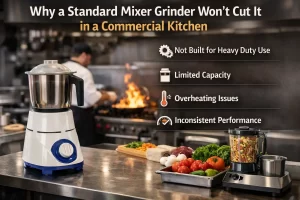
Before diving into the specifics, it’s vital to understand the chasm between domestic and commercial mixer grinders. A home unit, even a high-end 1000W model, is designed for short bursts of operation. It handles the needs of a family, not a full-service restaurant.
A commercial mixer grinder, however, is built for:
- Endurance: Designed to run for longer cycles without overheating.
- Volume: Capable of processing kilograms of ingredients daily.
- Power: Engineered to grind the toughest spices and densest batters effortlessly.
- Durability: Constructed with robust materials to survive the demanding environment of a professional kitchen.
Investing in a proper commercial unit isn’t an upgrade; it’s a necessity for any serious culinary business looking for efficiency and reliability. This commercial mixer grinder buying guide will help you identify a machine that meets these professional standards.
1. Mixer Grinder Motor Power: The Engine of Your Kitchen
The heart of any mixer grinder is its motor. The mixer grinder motor power, measured in wattage, is the most critical factor determining its performance. For commercial use, more power is almost always better.
- Wattage Requirement: Do not consider anything below 1000W. For light commercial use like in a small café, 1000W to 1200W might suffice. For a standard restaurant or hotel kitchen, the ideal range is 1300W to 1800W. This level of power provides the necessary torque to grind dense ingredients like turmeric or large batches of dosa batter without straining the motor.
- Motor Winding: This is a key part of any mixer grinder quality check. Insist on a motor with 100% copper winding. Copper is a more efficient conductor of electricity than aluminum, which means it generates less heat, consumes power more effectively, and has a much longer operational life. An aluminum-wound motor will overheat faster and is more prone to burning out under a commercial load.
- RPM (Rotations Per Minute): A higher RPM (around 18,000 to 22,000) means faster grinding. However, raw speed isn’t everything. Look for a machine with variable speed controls. This allows chefs to start slow for chopping ingredients and then increase the speed for fine grinding. A ‘pulse’ or ‘incher’ function is also invaluable for breaking down hard items or achieving a coarse texture.
When following a commercial mixer grinder buying guide, prioritizing a powerful, copper-wound motor with variable speed is the first step toward a wise purchase.
2. Jars and Capacity: The Right Tools for the Job
The jars are where the magic happens. Their size, material, and design directly impact your kitchen’s workflow and efficiency. Pay close attention to the mixer grinder capacity and jar specifications.
- Jar Material: Always opt for high-grade stainless steel (SS 304 is the standard). It is food-safe, hygienic, resistant to rust and corrosion, and durable enough to withstand the impact of hard ingredients. The jars should have a certain heft to them; flimsy, lightweight steel is a sign of poor quality.
- Jar Capacity: A good commercial model should come with at least two to three jars of varying sizes.
- Large Wet Grinding Jar (2-5 Liters): Essential for making batters, purees, and gravies in bulk.
- Medium Dry/Wet Jar (1-1.5 Liters): Perfect for grinding spices, making ginger-garlic paste, and other daily tasks.
- Small Chutney Jar (0.5-1 Liter): Useful for smaller quantities and specialized blends.
- Blade Design: The blades should be made from hardened stainless steel. Check that they are sharp and securely riveted to the base. Different jars will have different blade designs optimized for their purpose (e.g., flat blades for dry grinding, domed blades for wet grinding).
- Lids and Handles: The lids must fit snugly and be made from durable, shatter-proof polycarbonate or high-quality plastic. Look for lids with rubber gaskets to prevent leakage. Secure locking clips are a non-negotiable feature for hands-free operation and safety. Ergonomically designed, sturdy handles are also crucial for safely managing heavy jars.
3. Build Quality and Durability: Built to Last
A professional kitchen is a tough environment. The best commercial mixer grinder must be built to withstand daily abuse. This is a critical section of any commercial mixer grinder buying guide.
- Body Material: The outer body houses the powerful motor and must be robust enough to handle intense vibrations. Look for high-quality, shock-proof ABS plastic or, for ultimate durability, a full metal body. A sturdy body ensures the machine remains stable on the counter during operation.
- Couplers: The coupler is the small part that connects the motor to the jar’s blade assembly. It is a common point of failure. Avoid models with cheap plastic couplers. The best options are made from tough, heat-resistant nylon or, even better, metal. A robust coupler ensures efficient power transfer and prevents shearing under heavy loads.
- Ventilation System: A heavy duty mixer grinder India-based kitchens need must have an excellent cooling system. Look for well-designed air vents that allow for efficient heat dissipation. A motor that stays cool will perform better and last longer. Some premium models even have advanced cooling fans.
- Base and Feet: The base of the grinder should be heavy and fitted with vacuum suction or rubber feet. This prevents the machine from “walking” or vibrating off the counter when operating at high speeds.
Also, Read: Top 30 Commercial Mixer Grinder Brands in B2B Industries
4. Mixer Grinder Safety Features: Protecting Your Staff and Investment
Safety is paramount in a professional kitchen. A powerful machine like a commercial mixer grinder must come with essential mixer grinder safety features. Never compromise on these.
- Overload Protection Switch: This is the most important safety feature. It’s a small, resettable switch (usually a red button at the bottom of the unit) that automatically cuts power to the motor if it gets overloaded or overheats. This single feature prevents motor burnout and is a must-have.
- Lid Lock Mechanism: High-speed grinding creates immense force inside the jar. A secure lid lock prevents the lid from flying off, which could cause serious injury and a huge mess. This allows for safe, hands-free operation.
- Jar Safety Lock: Some models have a system that prevents the motor from starting unless the jar is correctly placed and locked onto the main unit. This prevents accidental starts and damage to the couplers.
- Shock-Proof Body: As mentioned earlier, an ABS or properly insulated metal body protects the user from any risk of electric shock, which is crucial in a wet kitchen environment.
A thorough commercial mixer grinder buying guide must emphasize that a lower price can never justify the absence of these core safety mechanisms.
5. Warranty, Service, and Brand Reputation
Your relationship with the manufacturer doesn’t end at the time of purchase. After-sales service is a critical factor that is often overlooked.
- Warranty: Look for a comprehensive warranty. A good commercial model should offer at least a 1-2 year warranty on the entire product and a longer warranty (3-5 years) specifically for the motor. This shows the manufacturer’s confidence in their product.
- Service Network: Choose a brand with a strong and responsive service network in your area. In a commercial setting, you cannot afford to have a machine down for weeks waiting for a technician or a spare part. Research the brand’s reputation for after-sales support.
- Availability of Spares: Over time, parts like jar gaskets, couplers, and blades will wear out. Ensure that these spare parts are readily and affordably available. A machine is useless if you can’t find a replacement for a simple rubber ring.
The Ultimate Mixer Grinder Quality Check Checklist
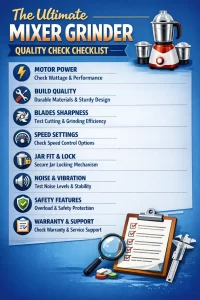
Before you finalize your purchase, run through this quick checklist. This is the final step in this commercial mixer grinder buying guide.
- Motor: Is it 1200W or higher? Is it a 100% copper-wound motor?
- Jars: Are they made of thick, high-grade stainless steel? Is the capacity sufficient for your needs?
- Blades: Are they sharp, thick, and made from hardened stainless steel?
- Body: Is it made from sturdy ABS plastic or metal? Does it have vacuum feet for stability?
- Safety: Does it have overload protection, a lid lock, and a shock-proof body?
- Controls: Does it offer multiple speed settings and a pulse function?
- Couplers: Are the couplers made of sturdy metal or high-grade nylon?
- Warranty & Service: Is the warranty period adequate? Does the brand have a good service reputation?
- Noise Level: While all commercial grinders are loud, listen to it run if possible. Some models have better noise insulation than others.
Conclusion: Making an Informed Decision
Choosing the right machine is a foundational step in setting up a successful professional kitchen. This commercial mixer grinder buying guide has outlined the essential factors to consider, from the raw power of the motor to the critical safety features that protect your staff. Remember that the initial price tag is only one part of the equation. The true cost of commercial kitchen equipment includes its longevity, efficiency, and the reliability of its performance under pressure.
By conducting a thorough mixer grinder quality check and focusing on motor power, build quality, jar capacity, and after-sales support, you can invest confidently in a heavy duty mixer grinder India‘s demanding kitchens require. A powerful, reliable mixer grinder is not just a tool; it’s a partner that will help you deliver exceptional quality and consistency to your customers, day in and day out.
Also, Read: Best Commercial Mixer Grinder in India for Restaurants & Hotels
Frequently Asked Questions (FAQs)
1. What are the top 3 things to check before buying a commercial mixer grinder?
The top three things are:
1) Motor Power: Ensure it’s 1200W or higher with a 100% copper winding.
2) Build Quality: Check for a sturdy ABS or metal body and high-grade stainless steel jars.
3) Safety Features: Verify the presence of an overload protection switch, lid locks, and a jar safety lock.
2. What is the ideal mixer grinder motor power for a restaurant?
For a medium to large restaurant, the ideal mixer grinder motor power is between 1300W and 1800W. This provides sufficient power for continuous, heavy-duty grinding of batters, spices, and gravies without straining the motor.
3. Why is a copper motor important in a heavy-duty mixer grinder?
A 100% copper winding motor is crucial because copper is a highly efficient conductor. It runs cooler, consumes less energy for the same output, and has a significantly longer lifespan compared to cheaper aluminum winding motors, which are prone to overheating and burnout.
4. What mixer grinder capacity do I need for a hotel kitchen?
For a hotel kitchen, look for a model that includes a large wet grinding jar with a capacity of at least 2 to 5 liters for batters and purees. Accompanying jars of 1-1.5 liters for masalas are also essential for versatile use.
5. What are the essential mixer grinder safety features for a commercial kitchen?
The non-negotiable mixer grinder safety features are an overload protection switch to prevent motor burnout, secure lid locks to prevent spills and injuries during operation, and a shock-proof body to protect users from electrical hazards.
6. How do I perform a mixer grinder quality check in the store?
Examine the unit’s weight and stability. Check the thickness of the stainless steel jars and the sharpness of the blades. Inspect the couplers to ensure they are metal or hard nylon, not flimsy plastic. Finally, confirm the warranty details and the brand’s service network.
7. Is a higher RPM always better in a mixer grinder?
While a high RPM (Rotations Per Minute) leads to faster grinding, control is more important. The best commercial mixer grinder will have variable speed controls and a pulse function, allowing the chef to adjust the speed based on the ingredient and desired texture.