

750 Watt vs 1000 Watt Mixer Grinder – Which One Should You Buy?

Standing in the appliance aisle or scrolling through endless options online can be overwhelming. You know you need a powerful kitchen companion, but the numbers on the box can be confusing. Specifically, the battle of 750 watt vs 1000 watt mixer grinder motors leaves many home cooks scratching their heads. Does that extra 250 watts really make a difference? Is it worth the extra money, or is it just marketing hype?
This guide breaks down everything you need to know. We aren’t just looking at numbers; we are looking at how these machines perform in a real Indian kitchen. From grinding tough turmeric to making silky smooth idli batter, your choice of wattage matters more than you might think. Let’s dive into the details to help you find the best watt mixer grinder for your specific needs.
Understanding Mixer Grinder Motor Power
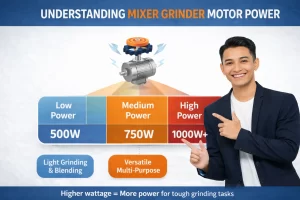
Before we jump into the direct comparison, we need to understand what “wattage” actually represents in a mixer grinder. Wattage is simply a measure of the power the motor consumes and, by extension, the power it can deliver to the blades.
Why Wattage Matters
The mixer grinder motor power dictates the torque and speed at which the blades rotate, especially under a heavy load. When you throw in hard ingredients like coconut pieces or dried spices, a low-wattage motor might slow down or overheat. A high power mixer grinder maintains its speed even when the jar is full of tough ingredients.
- Low Wattage (500W – 600W): Good for chutneys and soft grinding. Struggles with heavy loads.
- Medium Wattage (750W): The standard for most Indian households. Handles most tasks well.
- High Wattage (1000W+): Built for heavy-duty tasks, commercial use, or large families.
750 Watt vs 1000 Watt Mixer Grinder: The Core Differences
When comparing a 750 watt vs 1000 watt mixer grinder, the primary difference lies in efficiency and speed under load.
A 750 watt mixer grinder is often considered the “sweet spot” for domestic kitchens. It balances power consumption with performance. It can handle idli batter, spice grinding, and daily chutneys without breaking a sweat.
On the other hand, a 1000 watt mixer grinder is a beast. It grinds faster and finer. If you need to grind turmeric (haldi) into a fine powder at home, or if you make batter for 10 people every morning, this is the category you look at. It is often marketed as a heavy duty mixer grinder India loves for its robustness.
Let’s break down the comparison further.
1. Grinding Efficiency and Speed
In the 750 watt vs 1000 watt mixer grinder debate, speed is a major factor. A 1000W motor will grind ingredients roughly 25-30% faster than a 750W motor. This might save you only a few minutes per session, but over a year, that adds up. More importantly, the 1000 watt mixer grinder produces a finer texture much quicker, which is crucial for recipes requiring smooth pastes.
2. Handling Tough Ingredients
Have you ever heard your mixer groan while grinding soaked rice? That’s the motor straining. A 750 watt mixer grinder handles soaked rice and dal well, but you might need to give it breaks to cool down. A 1000 watt mixer grinder powers through these tasks continuously. For ultra-hard ingredients like solid turmeric roots or heavy coconut chunks, the higher wattage is safer and more effective.
3. Power Consumption
Naturally, higher wattage means higher electricity usage. However, because a 1000 watt mixer grinder finishes the job faster, the difference in your electricity bill might be negligible. A 750 watt mixer grinder runs longer to achieve the same result, potentially balancing out the cost.
Deep Dive: The 750 Watt Mixer Grinder
The 750 watt mixer grinder is the undisputed champion of the average Indian kitchen. It is versatile, affordable, and powerful enough for 90% of cooking tasks.
Who is it for?
- Small to Medium Families: If you cook for 3-5 people.
- Daily Cooking: Ideal for making chutneys, curry pastes, and spice powders.
- Budget-Conscious Buyers: Generally more affordable than 1000W models.
Performance Analysis
When discussing mixer grinder performance, the 750W motor offers excellent reliability. It doesn’t heat up as quickly as 500W models. Most reputable brands ensure their 750W motors come with overload protection, making them durable for years of use. If you aren’t running a catering business from your kitchen, this is likely the best watt mixer grinder for you.
Pros and Cons
Pros:
- Energy efficient.
- Lower noise levels compared to high-power units.
- Compact designs available.
- Cost-effective.
Cons:
- Takes longer to grind hard substances.
- Might require breaks during long grinding sessions (like large batches of batter).
- Not suitable for commercial-grade grinding.
Deep Dive: The 1000 Watt Mixer Grinder
Enter the powerhouse. The 1000 watt mixer grinder bridges the gap between domestic appliances and commercial mixer grinder wattage.
Who is it for?
- Large Families: Cooking for 6+ people regularly.
- Traditional Cooks: Those who grind their own difficult spices (turmeric, cinnamon sticks) regularly.
- Time Savers: People who want the job done in seconds, not minutes.
- Commercial Use: Small cafes or home-bakers.
Performance Analysis
This is a high power mixer grinder designed for endurance. The torque generated by a 1000W motor ensures that the blades don’t get stuck, even when the jar is packed. If you are looking for a heavy duty mixer grinder India relies on for festival cooking—where the mixer runs for hours—this is your best bet.
Pros and Cons
Pros:
- Superior grinding speed and texture.
- Can run for longer periods without overheating (depending on the cooling system).
- Crushes the hardest ingredients effortlessly.
- Durable build quality (usually heavier motors).
Cons:
- More expensive.
- Louder operation (more power = more noise).
- Bulky; takes up more counter space.
- Higher immediate power draw.
750 Watt vs 1000 Watt Mixer Grinder: Noise Levels
Noise is often the dealbreaker. A mixer grinder is inherently noisy, but wattage plays a role.
- 750 Watt: Loud, typically ranging between 80-90 dB. It is manageable for short bursts.
- 1000 Watt: Very loud. The powerful motor creates more vibration and air movement. If you have a baby at home or are sensitive to noise, you might find the 1000 watt mixer grinder intrusive early in the morning.
However, many modern high power mixer grinder models now come with sound-insulating bodies or “silent” technology. If you opt for 1000W, look for these features.
Durability and Build Quality
When you buy a heavy duty mixer grinder India manufacturers usually pair higher wattage with better build quality.
- 750W Models: Usually come with plastic bodies and stainless steel jars. They are durable but lightweight.
- 1000W Models: Often feature sturdier ABS plastic or even metal bodies to withstand the high vibration of the powerful motor. The jars are often thicker, and the blades are sharper and harder to handle the increased torque.
In the 750 watt vs 1000 watt mixer grinder longevity battle, a 1000W motor is less likely to burn out from overload because it isn’t working as close to its maximum capacity during normal tasks.
Commercial Mixer Grinder Wattage vs. Domestic Needs
It is easy to get carried away and think “more is better.” But do you need commercial mixer grinder wattage in a home kitchen?
Commercial grinders often start at 1000W and go up to 2000W. They are designed to run continuously for hours. A 1000 watt mixer grinder for home use is a hybrid. It gives you commercial-like performance for short durations.
If your usage involves grinding 2kg of idli batter every Sunday, a 750W machine will struggle and heat up. A 1000W machine will breeze through it. But if you only make a small cup of chutney daily, paying for a 1000W motor is overkill.
Also, Read: Top 30 Commercial Mixer Grinder Brands in B2B Industries
Price Comparison: Is the Upgrade Worth It?
Price is usually the deciding factor.
- A good quality 750 watt mixer grinder in India costs between ₹3,000 and ₹5,000.
- A branded 1000 watt mixer grinder typically starts from ₹6,000 and can go up to ₹10,000 or more.
The Verdict on Value:
If you choose the 750 watt vs 1000 watt mixer grinder based purely on budget, the 750W wins. But if you factor in the time saved and the longevity of the motor when handling heavy loads, the 1000W offers great long-term value for serious cooks.
How to Choose the Best Mixer Grinder Watt for Your Kitchen

Still undecided? Use this checklist to determine the best mixer grinder watt for you.
Choose a 750 Watt Mixer Grinder If:
- You have a family of 4 or fewer.
- You mainly grind chutneys, ginger-garlic paste, and soft spices.
- You make idli/dosa batter once a week in moderate quantities.
- You have a limited budget.
- You prefer a lighter appliance that is easier to move around.
Choose a 1000 Watt Mixer Grinder If:
- You have a large family or entertain guests frequently.
- You make batter in large batches multiple times a week.
- You grind tough ingredients like turmeric, coconut shell, or roasted coffee beans.
- You value speed and ultra-fine texture over price.
- You want a heavy duty mixer grinder India-style that lasts for a decade.
Key Features to Look for Beyond Wattage
While the 750 watt vs 1000 watt mixer grinder decision is crucial, other features affect performance.
1. RPM (Rotations Per Minute)
Higher wattage usually supports higher RPM, but not always. Look for a mixer with 18,000 to 22,000 RPM. This ensures quick grinding. However, for 1000W models, ensure there is a speed control knob. Running at full speed isn’t always good for delicate ingredients.
2. Copper Motor
Whether you buy a 750W or 1000W model, ensure it has a 100% copper winding motor. Copper conducts electricity better than aluminum, generates less heat, and improves mixer grinder performance.
3. Overload Protection
This is non-negotiable. Both 750 watt vs 1000 watt mixer grinder models must have a circuit breaker button (usually red, at the bottom). This prevents the motor from burning out in case of voltage fluctuation or overloading.
4. Jar Lock and Lid Locks
With the high torque of a 1000 watt mixer grinder, secure locking mechanisms are vital. You do not want the jar flying off mid-grind. Look for lid locks that allow hands-free operation.
Maintenance Tips for High Power Mixer Grinders
To ensure your best watt mixer grinder lasts long, follow these maintenance tips regardless of the power:
- Don’t Overfill: Even a 1000W motor can jam if you stuff the jar to the brim. Fill it only up to 75% capacity.
- Start Slow: Always start at speed 1 and gradually move to speed 3. Starting at high speed puts sudden stress on the motor.
- Pulse Mode: Use the ‘Pulse’ or ‘Incher’ button for dry grinding initially to break down large chunks before continuous grinding.
- Cool Down: If the mixer feels hot, give it a 5-minute break. This is especially important for 750W models during batter preparation.
750 Watt vs 1000 Watt Mixer Grinder: The Final Comparison Table
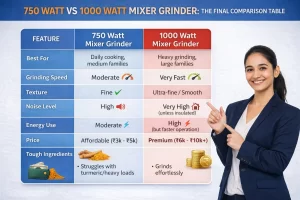
| Feature | 750 Watt Mixer Grinder | 1000 Watt Mixer Grinder |
| Best For | Daily cooking, medium families | Heavy grinding, large families |
| Grinding Speed | Moderate | Very Fast |
| Texture | Fine | Ultra-fine / Smooth |
| Noise Level | High | Very High (unless insulated) |
| Energy Use | Moderate | High (but faster operation) |
| Price | Affordable (₹3k – ₹5k) | Premium (₹6k – ₹10k+) |
| Tough Ingredients | Struggles with turmeric/heavy loads | Grinds effortlessly |
Conclusion
The debate of 750 watt vs 1000 watt mixer grinder ultimately comes down to your cooking style.
If you are a standard home cook looking for a reliable machine for daily curries and breakfast batters, the 750 watt mixer grinder is the practical, economical choice. It is the workhorse of Indian kitchens and rarely disappoints.
However, if you demand perfection, speed, and the ability to grind anything from stones to spices, the 1000 watt mixer grinder is the investment you need to make. It brings commercial mixer grinder wattage power to your countertop, ensuring you never have to worry about a stalled motor or coarse chutney ever again.
Assess your kitchen needs, check your budget, and choose the power that empowers your cooking!
Also, Read: Mixer Grinder Buying Guide for Home & Commercial Use
Frequently Asked Questions (FAQs)
1. Which is better, 750 watt or 1000 watt mixer grinder?
It depends on your usage. For regular daily cooking in a medium-sized family, a 750-watt mixer is sufficient and energy-efficient. For heavy-duty grinding, large families, or tough ingredients like turmeric, a 1000-watt mixer grinder is better due to its higher power and speed.
2. Is 750 watts enough for a mixer grinder?
Yes, 750 watts is widely considered the best mixer grinder watt for most Indian households. It handles idli batter, chutneys, and dry masala powders effectively without consuming excessive electricity.
3. Does a 1000 watt mixer grinder consume more electricity?
Technically, yes, a 1000 watt mixer grinder consumes more power per minute than a 750W model. However, because it grinds significantly faster, it runs for a shorter time, meaning the overall impact on your electricity bill is minimal.
4. Can a 750 watt mixer grinder grind turmeric?
A 750 watt mixer grinder can grind turmeric, but you must break the turmeric into small pieces first. Grinding whole, solid dry turmeric roots can strain the motor. For this specific task, a 1000 watt mixer grinder is much safer and more efficient.
5. What is the best wattage for a mixer grinder for home use?
For a balance of performance and price, 750 watts is ideal. If you want a high power mixer grinder that ensures professional-grade smoothness and handles heavy loads, 1000 watts is the premium choice for home use.
6. Is a higher watt mixer grinder better?
Generally, yes. Higher wattage means more torque and speed, leading to finer grinding and better handling of heavy loads. However, they are also noisier and more expensive. You should choose based on your actual requirement rather than just high numbers.
7. Which mixer grinder is best for idli batter?
Both can do the job, but if you make large quantities frequently, the 1000 watt mixer grinder is superior. It grinds the soaked rice and dal into a fluffy, smooth batter much faster and without overheating as quickly as lower wattage models.